
Worldline Takes this HERO Stuff Seriously

1048611_202260563263206_1402899811_o

John Stix, Amanda Little, Dawn Gamble & Mike Young in uniform

Yes, we have our Super hero kids all over the place. And yes, we’re about to roll out a whole slew of fun stuff with our kids over the next few weeks and months, and they are doing an awesome job representing what we are all about. They’re young, fresh, insurgent and shaking things up in Canadian telecom. However at Worldline, being a hero isn’t a marketing exercise. It’s not about brand. It’s how we go about our business.

The HERO concept for business was first introduced over 10 years ago, and its aim is to engage management to lead their teams with positivity and enhancing everyone’s outlook and performance outcomes. Worldline’s management strive to emphasize strengths, and celebrate success which raises the level of enthusiasm across the board. They encourage their staff in their work by providing them with every opportunity to be successful, and to support them on their path. Researchers call this Psychological Capital (PsyCap) in the workplace. Broken down, it works like this:

  • Hope: persevering toward goals and, when necessary, redirecting paths to goals in order to succeed
  • Efficacy: Self-Efficacy is having confidence to take on and put in the necessary effort to succeed at challenging tasks
  • Resilience: when beset by problems and adversity, sustaining and bouncing back and even beyond to attain success
  • Optimism: making a positive attribution and expectation about succeeding now and in the future

Sticking with an acronym kind of changes the emphasis, as what should really be first is the Efficacy piece. Having our Worldline people know they can go after issues before they become problems allows us to remain a lean, service-oriented company whose focus is on keeping our existing customers happy as possible, and to attract new business by being as awesome as we can. We are constantly improving our processes to maximize the level of service we provide while keeping our prices around the lowest in the country.

Or as we describe it, To deliver happiness and connections everyday by being awesome. It’s all about letting everyone at Worldline be a HERO.

The Raptors Culture: Going “all in” works

ed40a9b0-c653-11e3-aab4-69cdea6f079e_TORtopper41714Going into this season the Toronto Raptors were picked to finish at the bottom of their division, and after a horrendous start, they fired their GM, ditched their two name players and looked like they were on the road to a record dismal enough to warrant a high lottery pick for the highly anticipated 2014 draft. That looked like the plan, to tank.
But that’s not what head coach Dwane Casey and their new GM, Masai Ujiri thought. They liked what they had, and believed all that needed to happen was for their players to not only start believing in themselves, but each other as well. They needed everyone to buy into a team concept.

In the NBA, this is rarer than most think as many the players see playing basketball as a business first, and a team game second. Franchise loyalty is limited to a select few organizations, like the Mavericks and the Spurs for example, who have established their own identity, with a core group of players over a number of successful seasons. Not a group cobbled together in mid-season like the 2013-14 Raptors.

Casey revealed this week what the turning point was. Shortly after the all-star break he asked everybody in the organization to sign a declaration with the simple message being “I’m all in.”

“Kyle [Lowry] was the first to jump up and sign it,” Casey said.

For the remainder of the season, the Raptors played as a cohesive unit, giving off a one-for-all vibe and they started winning. They had the second best record in the NBA after all star break and went on to win their division. In the post-season, against a NY Nets team whose starting lineup had a combined 417 post-season starts between them, (compared to the Raptors’ zero), the Raptors took them to 7 games. In the end Lowry’s last second, and what would have been series winning shot, was blocked.

Due to a mid-season change in attitude, they transformed themselves from team that was looking to tank for a high draft pick, to one that was a single play away from winning a seven-game playoff series in for the first time in franchise history.

“Each player dedicated themselves, gave themselves to the season, and also, as far as I’m concerned, to the future,” said Casey. “This year was just a start of what we want to grow and develop with Masai as our leader and also the guys that are coming back here.”

The fans of the Raptors had a thrill ride, and after what they saw this year are chomping at the bit for next season even though this one just ended. They’re “all in” as well.

We here at Worldline found the team very inspiring – and very familiar.  We’re a group of scrappy underdogs as well, taking on Big Telco, and over the past number of years, we’re really rocking it. The number one reason? The folks at Worldline, from our Co-Founders on down, are all “in,” and so are our loyal customers.

The big difference between the Raptors and us? Exactly, that “big” part.

From all of us here at Worldline, congratulations to the Toronto Raptors on a remarkable season, and thanks for the inspiration both on and off the court.

We can’t wait for next season.


When it comes to happiness, we’re No. 5!

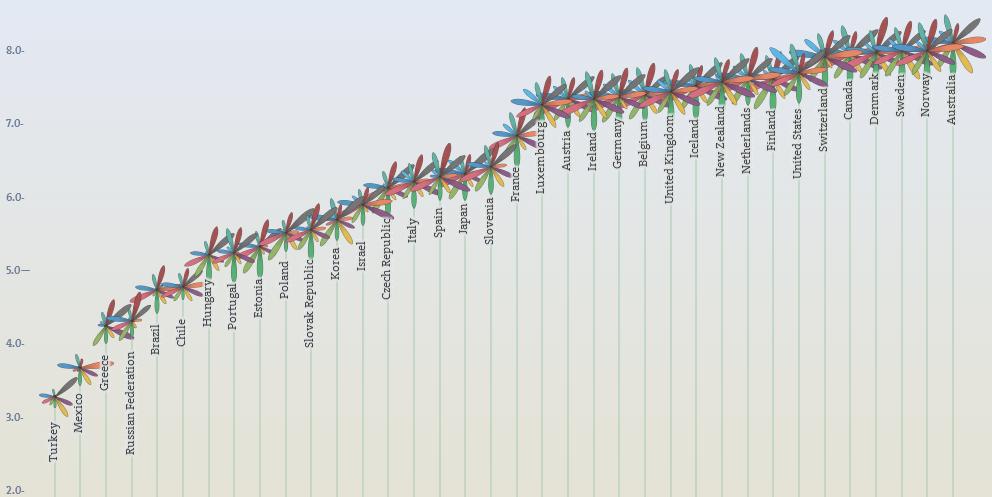
OECDReleased Monday, the “Better Life Index” from the Organization for Economic Co-operation and Development reveals for the first time what more than 60,000 people around the world believe to be the most important factors for quality of life.

The index ranks countries according to 11 different criteria, which it views as essential to a happy life. Indicators include community, education, environment, civic engagement, health, housing, income, jobs, life satisfaction, safety and work-life balance.

“Canada performs very well in many measures of well-being, as shown by the fact that it ranks among the top countries in a large number of topics in the Better Life Index,” reads the report.

Australia took the top spot while Norway and Sweden came in second and third, respectively.

Of course the most important number out of this study for we insecure Canadians is, where does the U.S. rank? They’re No.7, which should make us even happier.

Key Canadian Stats

In Canada, 89 per cent of adults aged 25-64 have earned the equivalent of a high-school degree, well above the OECD average of 75 per cent.

“This is truer of women than of men, as 88 per cent of men have successfully completed high-school compared with 90 per cent of women,” reads the report. “This reverses the OECD average picture, where men are slightly more likely to have graduated high school.”

According to the report, Canada is a top-performing country in terms of the quality of its educational system where the average student scored 522 in reading literacy, math and science in the OECD’s Programme for International Student Assessment (PISA).

“This score is higher than the OECD average of 497, making Canada one of the strongest OECD countries in students’ skills,” says the report. “On average in Canada, girls outperformed boys by eight points, lower than the average OECD gap of 10 points.”

The report also found that in Canada, over 72 per cent of people aged 15 to 64 in Canada have a paid job, more than the OECD employment average of 65 per cent.

Life expectancy at birth in Canada is 81 years, one year higher than the OECD average of 80 years.

In general, 80 per cent of Canadians said that they have more positive experiences in an average day, which include feelings of rest, pride in accomplishment, enjoyment, etc., than negative ones such as pain, worry, sadness, boredom, etc.

Worldline isn’t in the Disclosing Business

space_callAnother bombshell went off in Canadian telecom Thursday morning when it was revealed that at least one Canadian telecom is evidently giving the Canadian government unrestricted access to communications on its network, according to documents from Canada’s privacy commissioner.

The Huffington Post reports that the documents, obtained by University of Ottawa digital law professor Michael Geist, cite an unnamed telecom firm as saying it had allowed the government to essentially copy the communication data moving on its networks.

“Interception of communications over data networks is accomplished by sending what is essentially a mirror image of the packet data as it transits the network of data nodes,” the privacy commissioner’s document states.

“This packet data is then sent directly to the agency who has obtained lawful access to the information. Deep packet inspection is then performed by the law enforcement agency for their purposes.”

“Deep packet inspection” is a method of analyzing internet traffic to determine the exact type of content. It can distinguish between emails, file-sharing and other types of internet communication, and can be used to build statistics about an internet user.

The statement appears in a document prepared by law firm Gowling Lafleur Henderson for the privacy commissioner. It summarizes nine telecom firms’ responses to questions about law enforcement access posed by the commissioner.

Geist called it “an incredible admission” in a blog post published Thursday.

Are there legal grounds for these disclosures? Who is doing this?” Geist asked. “Given the uncertainty and the enormous privacy implications, the Privacy Commissioner of Canada is surely entitled to investigate this admission using her current powers….”

In documents released Tuesday, interim federal privacy commissioner Chantal Bernier revealed that the government made about 1.2 million requests for subscriber data from Canadian telecoms in 2011. Geist calculates that works out to one request every 27 seconds. Telecom firms complied with the requests at least 784,000 times, the privacy commissioner’s report showed.

So – what does Worldline do? Not that.

I asked our CTO Francisco Dominguez earlier this year to spell out in the simplest terms what we do and don’t do when it comes to our customers data and information. It turns out, we don’t do much, and when we do disclose any information it’s under very specific circumstances with very strict guidelines:

Francisco says for telephone numbers, if a law enforcement agency (LEA) requests information and indicates it’s an imminent threat to life  we collect the law enforcement agency contact  details (badge/name/dept/LEA name/contact number) and confirm the LEA through a call back mechanism, then we provide address details for the subscriber limited to:

 First-name Last-name, address, city, postal code, alternate phone numbers

If a law enforcement agency requests information and does not indicate an imminent threat to life we require a warrant.

Once a warrant is received we provide the details outlined in the warrant only.

So, for the record, that’s our disclosure policy. Contact information only, and only when it’s a matter of life or death, or if we are presented with a warrant.

A Worldline Review – “It’s Called Customer Service”

worldline_iconWorldline is a weird company. Where other telecoms in Canada blackmail their customers into keeping from switching services by tying them down with restrictive, onerous, confusing and automatically renewing contracts, we don’t.

We’re different.

Worldline has no mandatory contracts. That means the only reason our customers stay with us is the service we deliver. They are free to leave us at anytime, but they don’t because, first and foremost, we provide them top quality Unlimited High Speed Internet and Home Phone service in the most cost-effective fashion possible. But

it’s also about our extraordinary customer service when those rare technical issues pop up. Below is a letter sent into our President and CEO Jody Schnarr this week and it sums up what we’re all about very, very well.

Good afternoon, Mr. Schnarr

We have recently signed on to Worldline for our home phone and internet needs. Your exceptional offers, rebates, everyday pricing, consistent speeds and call quality made it difficult NOT to join the Worldline family. But, I have to say none more so than 2 days ago.

An accident in our home physically destroyed our jack for phone and internet. Without service on either line, I drove to your Head office on Boxwood Drive to find out where you or your contracted employees purchase these jacks to replace ours. Your receptionist was more than willing to help, taking what I had brought to the “back”. An older man, grey haired with a goatee and glasses, warmly shook my hand and said jokingly “Well there’s your problem?” As we laughed, he took me to his car and proceeded to hand me a filter and wall jack as he did not recognize the one that was previously installed by the bell tech. I thanked him and proceeded to pull out my wallet to pay. “No charge” he replied. I was shocked….so I asked him again….he said “it’s called customer service.”

Mr. Schnarr, those are words that have been lost in today’s business models everywhere you turn. You have chosen to enter into, what I consider, one of the most cutthroat and backstabbing industries out there. You should be very proud of what you have accomplished, and the people who helped get you there. Many people, including myself, who experience instances like this will guarantee you continued success. Thank you for putting the customer first…..

Best wishes,

Darcy

One very satisfied customer

P.S. If you can track down the tech who helped me, with my vague description, thank him again.

Dave MajuryThat “tech” is our own David Majury. Dave has been in the telecom industry for decades and he is our Level 3 Support Team Leader. Worldline was lucky enough to drag him out of retirement, (Can you say “beer money?”) and help us out with our tech support. All of our people have benefited from not only his expertise but his absolute dedication to keeping our customers as happy as possible.

Darcy is just one example.