
 With so many ISP instituting caps and limits on their customers, government oversight agency gets set to investigate
By Terry Pedwell, The Canadian Press
Canada’s telecom regulator is asking Internet users whether they’re getting enough speed — and enough bang for their buck.
The Canadian Radio-television and Telecommunications Commission has launched a major fact-finding process to assess whether Canada has the right telecommunications to be a world-class player in the digital economy.
It wants to know what services Canadians need to be digitally competitive, what kind of upload and download speeds are needed, whether there should be funding tools in place for upgrading telecom equipment and how the industry players should be regulated.
The CRTC says it will gather information before holding public hearings on the issue a year from now.
As more government and public services are moved online, the regulator said it’s concerned that not everyone will benefit from such things as digital banking, health and other services.
“As our habits change in this digital age, our telecommunications services must keep pace,” CRTC chairman Jean-Pierre Blais said in a statement.
“Canadians are looking to the future, and the CRTC wants to ensure that the technology they depend on does so as well,” he said.
Please read the entire article here.
 It’s refreshing to learn that the CRTC is responding to the issues with the telecom marketplace because Canadians are paying far too much for their data connections, and many vendors are taking advantage of regional infrastructure issues and forcing many consumers to pay through the nose. By expanding the national broadband footprint, more Canadians will be able to pick and choose their service provider instead of just having to take it. Competition is good!
At Worldline, our entire business model is based on providing the best services possible at the fairest prices in the industry with no overage charges. All Worldline Internet is unlimited.
For more on what we can do for you, and just how much you can save, please visit the Worldline website or give us a call at 1-855-299-0025.
 Twenty six years ago last month, Professor Tim Berners-Lee’s issued a technical paper at a Swiss physics lab called Information Management: A Proposal. The result of that paper presented to CERN was the World Wide Web – a system for publishing information over something called the “Internet.” It finally debuted on August 6, 1991 when the World Wide Web was made a publicly available service. Since then pretty much everything in our daily lives has changed, from the way we gather information, the way we bank, are entertained and perhaps most of all, the way we interact.
 This should come as no surprise: Canadians are pretty much near or at the top of the list when it comes to their telecom expenses.
 Since
Since  57 down and 9 up. Pretty awesome for wireless really. Just out of curiosity (actually not, more on this in a bit), I tested my wireless speed on my iPhone 6 Plus, making sure I was the same distance from the router and the results were, well, surprising:
 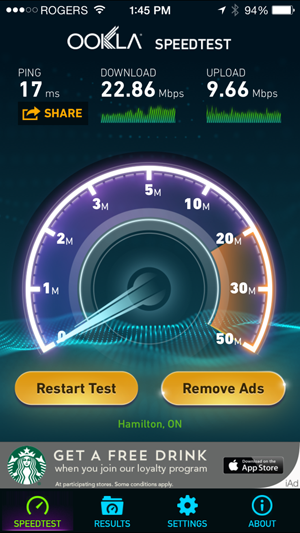 Ouch. 23 down and 10 up. Same WiFi, same router, even the same manufacturer, but the difference? Even with the iPhone 6 Plus being the latest and greatest (and biggest) mobile from Apple, it was only getting half the speed as my iMac. The reason I did this test was we see these same Ookla screen captures from our customers posted on our Facebook page complaining about their wireless speeds. Of course we immediately check out to see if there is anything up with their service, but more often than not, the issue is with their devices, not with us. So, here’s some (hopefully) helpful tips to make sure you are getting the best speeds possible on all of your wireless devices from our award winning tech team in our Cambridge head office: