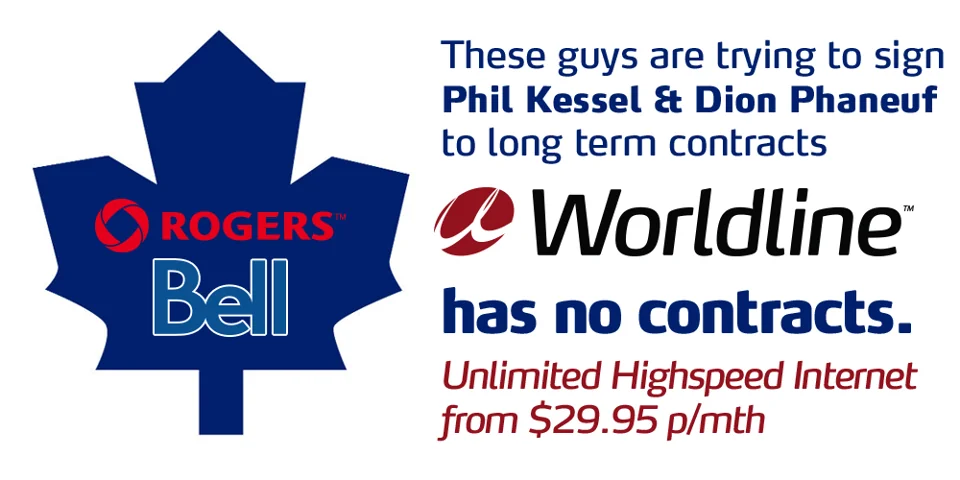
The Rogers/Bell/Leafs Triumvirate
Reply


That’s the question every company has to ask itself when they get into the microblogging thing. It breaks down like this:
“Why are we doing this?”
“What is the benefit?”
“Why would our customers follow us?”
“Who is going to be doing the Tweeting?”
“Do we have to pay them? (Which invariably followed by, “We have to pay them how much?”)
And of course, “Will it make us money?”
The thing is, these days, if a company is not on Twitter they are making a huge mistake.
And if customers aren’t following the companies that provide them with services, so are they.
Twitter is a revolution because there is no single better way to communicate with a company you are doing business with, or are thinking about doing business with, and get your voice heard immediately, than through Twitter.
None.
That’s because of two very powerful things:
It’s everywhere, and anybody can see it.
If you post on a corporate twitter feed, everybody gets to see what’s on your mind and guess what? Your problem is going to be dealt with as soon as humanly possible.
Because if it’s not, well, folks will tweet about it, and that’s generally bad.
For companies the exact opposite is true. If an organization come across a tweet from a customer with an issue, then resolves it, and then tweets about it; that’s called excellent customer service and that makes everybody look great.
This instant level of communication has never been around before. It’s transformed the relationship between company and client from a private matter to a public issue.
In other words, people suddenly have the power.
So, if you have one of our Worldline services, follow us @WorldlineCanada, and here’s what you’ll see on our feed:
…and finally, because all of that stuff is rather rare and a twitter feed always to be fed daily, (at least):
That’s what Worldline is here for: To save Canadians money, because they have been paying way too much for their Internet and Home Phone.
I read that on Twitter.

Netflix CEO Reed Hastings can’t understand why Canada’s broadband cap limits remain the lowest in the developed world.
We can’t understand it either.
Listening to our customers when they are signing up for Worldline’s unlimited broadband Internet, they aren’t happy about caps on their old service.
Not happy at all.
Almost invariably they’ll say something like, “I just want to make sure. You guys don’t cap right? Seriously. No cap?”
Seriously. No cap. Which means video streaming over the Internet, regardless of how much you watch, won’t cost you extra at the end of the month. It also means you can ramp up the Netflix video quality to its highest setting.
According to a report just released by the Canadian Internet Registration Authority, (CIRA), Canada is the No.1 nation in the world when it comes to watching video online, yet major Internet Service Providers (ISPs) like Rogers, Bell and Telus all just jacked up their broadband rates and are penalizing their customers in what can only be described as a blatant cash grab.
It’s not going unnoticed.
In an interview with the CBC at last month’s Consumer Electronic Show, Netflix spokesman Joris Evers said that Canadians would like to be able to use the service fully and as much as they want.
“We would love for Canadians to be unshackled of their bandwidth caps and stream as much as they want and have unlimited internet access,” he said. “Netflix is a killer app for broadband and because people want it, ISPs will sell larger packages to people and faster speeds. We drive a lot of demand for ISPs and we think they like that.”
Worldline like’s that.
The Canadian Radio-television and Telecommunications Commission last year estimated that about 10 per cent of adults subscribed to the service since its launch in 2010. Analysts believe that number is actually double.
And all of those millions of Canadians are probably pissed off at their ISPs.
If only they knew they had an alternative….
 Although Fibernetics and Worldline have nearly 200 employees spread around the world and 300,000 customers nation wide, we are still considered a small company. And in the world of telecommunications, this even more so because compared to the “incumbents,” we’re basically a bee-bee in a boxcar.
So how do we go head-to-head against those gigantors in this over-saturated marketplace – especially when the two biggest of the bigs have the Maple Leafs and the Blue Jays blowing their horn?
Now that is a tough one.
Worldline provides the same quality home phone and Internet services as both Bell and Rogers do; we just do it way cheaper because we can. It’s simple really. Our overhead, compared to theirs, is basically non-existent. We can make a nice profit and pass the savings off to our customers.
We don’t have a hockey team, or a soccer team, or a football team, or a stadium, or an NHL arena, or a baseball team, or TSN, or Sportsnet, or… you name it, they’ve got it.
All of that gives them massive awareness therefore massive market share, but also massive revenue requirements, and therefore expensive services.
This nearly universal market saturation results in the vast majority of folks out there not even knowing they have options when it comes to their home phone or Internet services.
It’s either Bell or Rogers – with the deciding factor usually being who they hate less.*
This is the place Worldline finds itself: equal in service, lower in price, yet comparatively speaking, virtually unknown.
We’re not one of the big boys (yet).
And for folks who want a quality product at a sane price, that’s a good thing.
Now we just have to let them know about it.
*Me? I could never ever go with Bell. They laid me off when I worked at TSN after acquiring the Maple Leafs 10-years ago this month. (Not that I’m still bitter or anything.)
 New report released from CIRA in January 2013 looks at the Internet and Canada’s place in it
Canadians rank first in the world when it comes to Internet usage, spending an average of 45 hours per month online. Despite this fact, Canadians still spend more for broadband speed than 19 other countries. These illuminating facts, and more, are included in a new resource from the Canadian Internet Registration Authority (CIRA) released today.
The 2013.CA Factbook is a compendium of facts and research about the global domain name industry and .CA’s place therein. It also provides a glimpse into the state of the Internet in Canada.
“I believe that Canadians will find the information within the Factbook revealing” said CIRA’s president and CEO Byron Holland. “From the increasing consumption of media content online to the continued growth of .CA, the Factbook provides a snapshot of an Internet landscape in Canada and around the world that is constantly evolving.
Some other facts of note include:
So, basically, it`s a good time to be the company that offers the most cost-effective unlimited Internet in the country.
Just saying.