Canada’s Not the Only Country With “Big Telco” Issues

Comcast-Logo-BlackCanadians know all about the consequences of having the just a few companies dominate the telecommunications marketplace. Limiting the options when it comes to who can provide national services and who can’t limits competition and innovation and leads to price gouging and unfair business practices.

As of last week, it looks like our friends south of the border are heading down the same path.

The New York Time’s Nobel Prize winning economics columnist, Paul Krugman wrote a scathing take-down on a proposed merger in the U.S. that would make Comcast, already the biggest telecommunications company in that country even larger with its proposed acquisition of Time Warner Cable.

Here’s the key points:

Last week’s big business news was the announcement that Comcast, a gigantic provider of cable TV and high-speed Internet service, has reached a deal to acquire Time Warner Cable, which is merely huge. If regulators approve the deal, Comcast will be an overwhelmingly dominant player in the business, with around 30 million subscribers.

So let me ask two questions about the proposed deal. First, why would we even think about letting it go through? Second, when and why did we stop worrying about monopoly power?

On the first question, broadband Internet and cable TV are already highly concentrated industries, with a handful of corporations accounting for most of the customers. Once upon a time antitrust authorities, looking at this situation, would probably have been trying to cut Comcast down to size. Letting it expand would have been unthinkable.

Interestingly, one cliché seems to be missing from the boilerplate arguments being deployed on behalf of this deal: I haven’t seen anyone arguing that the deal would promote innovation. Maybe that’s because anyone trying to make that argument would be met with snorts of derision. In fact, a number of experts — like Susan Crawford of Benjamin N. Cardozo School of Law, whose recent book “Captive Audience” bears directly on this case — have argued that the power of giant telecommunication companies has stifled innovation, putting the United States increasingly behind other advanced countries.

wl_save_internetExcept for Canada of course. We are the poster child for how not to run a telecom industry. Due the concentration of customers in three mega-companies, practically every Canadian has a Big Telco story about how they were ripped off, and due to the restrictions in the marketplace, they have few places to turn.

Worldline is one of the few competitors out there who are throwing a wrench into the gears of Big Telco, forcing them to reign in their price gouging and unfair contracts. Yet, too few Canadians know that, a), they have an option in a service like ours, or b) too few have geographical issues that leaves them with only one provider.

The only way to beat these guys is first, government action to take the shackles off and let competition truly thrive. However, until that happens, what will really be a game changes is for more Canadians to simply just say “no” to Big Telco and take their business elsewhere.

Oh, by the way, our number is 1(855) 299-0025.

Calling All Olympians: Worldline Customers call Sochi for Free!

sochi_worldline

We’re loving the Olympics here at Worldline and are in awe of how well our team is doing. Since we just happen to be a telecom company, we thought, what can we do to help cheer our athletes on than letting our customers call them for FREE for the duration of the Sochi Games.

There are no tricks. Nothing special you have to do. Just call using the Sochi area code and that call will be credited on your next bill.

We invite you to with our athletes the best in their quest for Gold, Silver and Bronze in Sochi Russia – Go Canada Go!

Oh, and if you are not a Worldline Bundle customer, this is just part of the service you will come to expect once you join up. For more details on the Worldline Bundle, please go HERE.

Wordline Comes Clean About Their Customer’s Information

Michael_GeistMichael Geist is a law professor at the University of Ottawa where he holds the Canada Research Chair in Internet and E-commerce Law. He is also Canada’s premier writer on the telecommunications industry.

Last month he wrote a provocative column called Why Canada’s Telecom Companies Should Come Clean About Customer Information

Here’s a brief excerpt:

I wrote a column arguing that Canada’s telecom companies should come clean about their disclosures of customer information. That column was in response to a public letter from leading civil liberties groups and academics sent to Canada’s leading telecom companies asking them to shed new light into their data retention and sharing policies…to address the lack of transparency regarding how and when Canadians’ personal information may be disclosed without their knowledge to law enforcement or intelligence agencies.

Concerns with telecom secrecy has become particularly pronounced in recent months as a steady stream of revelations that have painted a picture of ubiquitous surveillance that captures “all the signals all the time”, sweeping up billions of phone calls, texts, emails, and Internet activity with dragnet-style efficiency.

Canada’s role in the surveillance activities remains a bit of mystery, yet there is little doubt that Canadian telecom and Internet companies play an important part as intermediaries that access, retain, and possibly disclose information about their subscribers’ activities.

Good points there, and we agree. The telecommunications industry must become more transparent.

So, we’ll go first. Here’s what we here at Worldline disclose.

I asked our CTO Francisco Dominguez to spell out in the simplest terms what we do and don’t do when it comes to our customers data and information. It turns out, we don’t do much, and when we do disclose any information it’s under very specific circumstances with very strict guidelines:

According to Francisco, for telephone numbers, if a law enforcement agency (LEA) requests information and indicates it’s an imminent threat to life  we collect the law enforcement agency contact  details (badge/name/dept/LEA name/contact number) and confirm the LEA through a call back mechanism, then we provide address details for the subscriber limited to:

 First-name Last-name, address, city, postal code, alternate phone numbers

If a law enforcement agency requests information and does not indicate an imminent threat to life we require a warrant.

Once a warrant is received we provide the details outlined in the warrant only.

So, for the record, that’s our disclosure policy. Contact information only, and only when it’s a matter of life or death, or if we are presented with a warrant. As Michael wrote, “Canadian telecom and Internet companies play an important part as intermediaries that access, retain, and possibly disclose information about their subscribers’ activities.”

Very true, and we don’t play that game.

Tech for Good: 54 Hours to Change the World

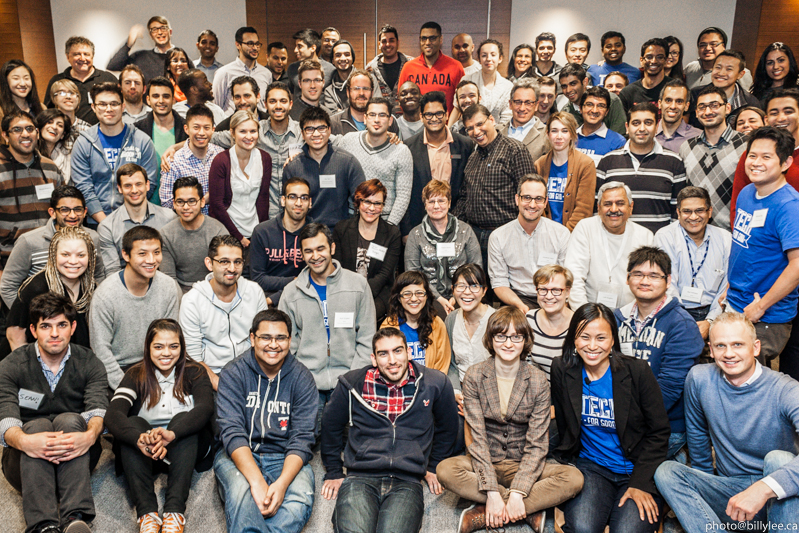
20140126-IMG_6969

What happens when you get the best and brightest young up and comers together with business leaders and innovators, like John Stix from Fibernetics? It turns out, some pretty cool stuff!

At the end of January, 100 plus of Canada’s top young entrepreneurs, mentors and advisers crammed themselves into a downtown corporate office at Startup Weekend Toronto and brainstormed, innovated and created with the goal of coming up with tech oriented products and services. A competition, it had the following parameters:

  1. Business Model – Customer Validation and acquisition strategy, Revenue model, Partnerships defined, Rollout strategy
  2. Technical – Is there a functional prototype (e.g.in the case of an app, did they build one)?
  3. Design – UX, Graphic design, Does it deliver a compelling and captivating user experience? What key insights were gathered over the weekend to go in the chosen creative direction?
  4. Social Value Proposition– What is the depth of the anticipated social impact for customers? What is the potential for the product/service to achieve a positive social impact at significant scale? Are there clear metrics and goals for measuring social impact over time? To what degree have social impact assumptions have validated?
1794660_637497042981808_44802500_n

John Stix mentoring

Boiled down, what they were after was, in just 54 hours, creating something that would change the world for the better.

They did,

And the winners were:

3rd Place

GivePlay | An online platform in the making for athletes and recreational players to easily find sport venues that fit their needs.

2nd Place

Spritely A Concierge service to preserve independence for senior citizens and improve their mental health.

1st Place

BuddyBench  An online platform that move universities and colleges from mental health awareness to mental wellness. While other counselling services may offer 24/7 and anonymous access, BuddyBench removes the barriers of inconvenient and intimidating counselling.

We’ll be following their progress as they bring these innovative ideas to market. Thanks to all who participated, and John can’t wait for the next group of brilliant young minds set on changing the world for the better.

1888601_641609635903882_1802948340_n

Worldline’s Insurgency Campaign Continues

Hero_Approved

Worldline Super Hero Kids Introduced Last Year

Last year, when we first re-launched Worldline, we talked about our Insurgent campaign:

Worldline provides the same quality home phone and Internet services as both Bell and Rogers do; we just do it way cheaper because we can. It’s simple really. Our overhead, compared to theirs, is basically non-existent. We can make a nice profit and pass the savings off to our customers.

We don’t have a hockey team, or a soccer team, or a football team, or a stadium, or an NHL arena, or a baseball team, or TSN, or Sportsnet, or… you name it, they’ve got it.

All of that gives them massive awareness therefore massive market share, but also massive revenue requirements, and therefore expensive services.

This nearly universal market saturation results in the vast majority of folks out there not even knowing they have options when it comes to their home phone or Internet services.

It’s either Bell or Rogers – with the deciding factor usually being who they hate less.*

This is the place Worldline finds itself: equal in service, lower in price, yet comparatively speaking, virtually unknown.

We’re not one of the big boys (yet).

And for folks who want a quality product at a sane price, that’s a good thing.

Now we just have to let them know about it.

That was from one of this blog’s 1st post published February 1st, 2013. One year later, how are we doing?

We just closed off the best year in our company’s history. We’ve added more customers, added more products like 50 Mbps Ultra High Speed DSL Internet and Unlimited Cable Internet, and saved Canadians more money than ever before in our 10 year history. Things are already looking awesome for 2014 as we just closed off our best January ever as well.

But beyond that, insurgency means shaking the foundations, being a game changer and making a difference.

Here’s the plan: What we’re going to do is to completely tear down the walls on telecom in Canada by revealing, for the first time, exactly how much, from an operational perspective, it costs to provide telecom service in this country, and how much, over the years you have been overcharged for your phone, long distance and Internet.

…and the gouging is still going on and on and on.

Worldline is going to be the transparent telecom in Canada in 2014. We’re getting the numbers together right now, so stay tuned to learn just how much you’re paying for what you are receiving.

And I suspect, prepare to be pretty pissed off.