NEWT™ All in One Voice Solution Saves Businesses up to 50 to 80 Per Cent on Their Monthly Telecommunications Services

NewtManagedPBXCAMBRIDGE, Ontario–()–In Canada, an average of 130,000 new businesses start up each year. For businesses the decision of which voice technology to use is a key budget priority. Telecommunications including: Internet, voice and mobile services are the single most important element to getting a business off the ground. Fibernetics™, a Cambridge based Telecommunications Company has proven to be invaluable for more than 1,000 businesses across Canada by providing affordable and reliable voice solutions. Fibernetics’™ new business voice solution brand NEWT™ saves the average business up to 50 to 80 per cent on their monthly telecommunications service. For small businesses, this cost saving is substantial, while medium to larger businesses can realize even greater savings.

“The NEWT™ brand offers our clients a flawless voice solution”

“The NEWT™ brand offers our clients a flawless voice solution,” explains Chris Lehman, Vice President of Business Services for Fibernetics™. “We are a one stop solution – the network provider, phone line provider, and we developed the NEWT™ Managed PBX Platform. By choosing NEWT™ customers are choosing a company that has the network, built the solution, and provides the integration, installation, training and support – there is no other offering like this on the market.”

Exclusive to the business voice solutions market, NEWT™ eliminates the cost of multiple business lines and replaces them with a single dedicated voice connection, or a high bandwidth, high availability, multi-use voice and data connection with a completely private path for the voice. Fibernetics™ also provides many other data and Internet options for business. Added to this is live support, provided 24 hours a day, everyday throughout the year. Clients also benefit from the “No Interruption Guarantee”, because the Fibernetics ™ team does not need to disable a clients’ current phone system when migrating to NEWT ™. Furthermore, the system includes unlimited conference bridging, voicemail, voicemail to email, call recording, and mobile integration in addition to more than 50 other features purpose built to improve communications for businesses of all sizes.

“The best part of our offering is that we include everything. There are no hidden charges or up sells. Our customers have saved significantly using NEWT™,” explains John Stix, CMO of Fibernetics™. “A recent case study of Discount Car and Truck Rental’s head offices proves NEWT™ to be an asset to day-to-day operations with savings of more than $2,000 on a monthly phone bill and double Internet speed following installation.”

“We’ve realized a saving of over $2,000 per month since switching to NEWT™. We were most impressed that the Fibernetics™ team makes sure everything was taken care of, our staff was fully trained prior to switching, and we had no interruption of our business lines when we made the switch,” comments Al Nanji, Vice-President of Discount Car and Truck Rentals.

Competing service providers use Virtual Private Networks (VPN’s), often over connections that they do not manage, and which are susceptible to the reliability of the Internet. In contrast, NEWT™ uses the Fibernetics™ CLEC privately managed network. Providing even more security than a VPN over the public Internet, the system manages the voice traffic from the regular public telephone network to the customer premise and vice versa.

“NEWT™ lived up to all of its promises. We have reduced our costs significantly, and are in the process of adding other locations across the country to this system,” adds Leonard Malley, AMJ Campbell.

About Fibernetics – fibernetics.ca

Over the last ten years, Fibernetics has emerged as one of Canada’s fastest growing and largest telecommunications companies. Fibernetics’ rapid success has been leveraged by a marriage of established legacy systems with emerging Internet protocol based technologies and underpinned by the unique experience of Fibernetics’ founders and management team, as pioneers of VoIP communications in Canada. Fibernetics is an operating Competitive Local Exchange Carrier (CLEC) regulated by the CRTC, which has direct connectivity into the heart of the incumbents’ fiber optic networks across Canada.

Fibernetics owns one of Canada’s largest coast-to-coast networks and supports over 300,000 customers daily. Fibernetics has over 200 employees globally with its head office in Cambridge, Ontario, Canada and two international offices located in Sofia, Bulgaria, and Puerto Plata Dominican Republic. Fibernetics under its residential Worldline brand has enjoyed incredible growth serves a very dedicated following. Worldline delivers Canada’s most inexpensive residential home phone, Internet and long distance services and never stops looking for innovative solutions to deliver value for Canadian families.

Fibernetics Business Services has developed a proprietary digital PBX system, NEWT™, which eliminates the cost of business phone lines for Canadian businesses of all sizes. This phone system is easily integrated into a business network and once installed delivers full PBX functionality normally associated with much more expensive systems. The PBX system is directly connected to the Fibernetics CLEC network, which provides scalability, reliability and quality of service. Currently, Fibernetics services over 25,000 business extensions in Canada and has recently launched a new brand for this product and service called NEWT™.

Worldline Announces the Lowest Priced Home Phone and High Speed Internet Bundle-Ever!

WorldlineLogoCAMBRIDGE, ONTARIO–(Marketwire -08/23/11)- Emerging Canadian telecommunications leader Worldline today announced a new low-priced and feature-rich home phone and high speed internet bundle for the Ontario market that is designed to bring down costs for consumers while offering outstanding service.
Today, the average Canadian household is paying around $100 dollars a month for basic wireline and broadband service, and must further shell out for long distance charges and for add-on services such as visual call display. Worldline comes out of the gate with an all-in bundled package at half of the cost.

For the low monthly cost of $49.95 plus a $5.00 regulatory and essential services fee, Worldline’s bundle is incredibly affordable. It is also simple to understand and customers can be up and running very quickly. There are no hidden fees, extra costs or contracts. As an extra bonus, this package includes free long distance to most destinations across Canada. And best of all – it comes with free installation.

“Worldline is taking a stand on behalf of the average Ontario family. In these challenging economic times, people everywhere are looking to reduce household costs. But at the same time, they need a dependable provider for quality home phone service, high speed internet, as well as attractive long distance calling. We want to be that provider,” says CEO Jody Schnarr.

Schnarr continues on to explain that Worldline’s efficient business operations and lean and mean approach to marketing enables the company to offer such low pricing to their customers. “Elaborate marketing campaigns and television commercials may help to build brand recognition, but they don’t serve the average consumer. We believe in passing savings along to our customers,” he notes.

Available to residents in Ontario today, Worldline’s Home Phone & Internet Bundle is just $49.95 per month and includes:

  • Home phone line
  • Voicemail
  • Voicemail to email
  • Call display
  • Call transfer
  • Call waiting
  • Visual call waiting
  • Call forwarding
  • Three-way calling
  • High speed internet
  • Unlimited bandwidth
  • Speeds up to 10Mbps/800Kbps
  • Virus & spam guard for email
  • Wireless modem
  • Free long distance calling across Canada (excluding Yukon, Nunavut, Northwest Territories)
  • Free professional installation

“Our phone and Internet through Worldline works great. The monthly invoice is easy to understand and we love the no-hassle convenience of our bill automatically charging to our credit card each month. The internet is always fast, no matter what we’re doing, and best of all we get all the phone features for free without paying an over-priced premium for them like with our old provider. Although we were hesitant to switch after being with our old provider for over 25 years, we will never look back,” say happy Worldline customers, Jim and Sherry.

The Budphone

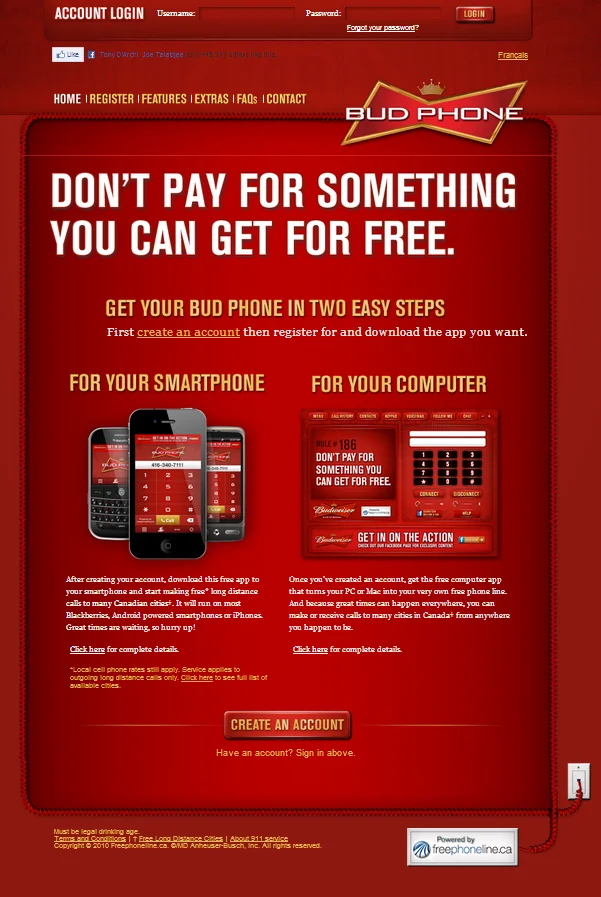
BudlineBy Rose Simone, Record staff CAMBRIDGE – A Cambridge based independent telecommunications company, Fibernetics, has teamed up with the Budweiser beer brand to launch a smartphone application, the BudPhone, that allows people using the BlackBerry, iPhone or Android devices to make free long-distance calls within Canada.


The smartphone application, which was developed over the course of two years by Fibernetics, uses the company’s freephoneline.ca service, which is a voice-over-internet service.  It routes calls so that they look like local calls and lets people avoid the long distance charges.

“So when you want to make a long distance call, you can just launch the application on your smartphone device, and you can either use your key pad or your contact list to call,” said John Stix, the chief marketing officer for Fibernetics in Cambridge.  “You can call within Canada completely free of charge and you can talk as often, for as long and as often as you want,” he added.  The service will work anywhere in the Fibernetics phone network – which covers all the major centres and about 85 per cent of Canada, Stix said. It doesn’t require listening to any audio advertising and there is no interference with the phone call, he said.

The reason it can be free is because voice-over-internet is actually very inexpensive to run, Stix said.

“Canadians pay the highest long distance rates in the world for cellphone calls. It is ridiculous for it to be as expensive as it is,” he said.

“By having us simply reroute the call over our network, which is a voice-over-internet-protocol network, similar to Skype, we are able to channel that call at fractions of a penny per minute and it doesn’t take much to cover the cost of providing the service.” The local calling charges still apply and it won’t change the terms of a regular cellphone contract, but the application is especially useful for people who travel or have children at university, he said.

The partnership for the BudPhone application is beneficial for Labatt Breweries in marketing the Budweiser brand because “one of our key demographics is that 19 to 24 year old drinker and those consumers are increasingly tech savvy,” said Ben Seaton, marketing manager for Budweiser.

It also provides those consumers with a technology that can help them to keep in touch with both their friends and family, he added.

To get the application, people register on the website, www.budphone.ca, which then sends a link to the user. They can then register their phone number and get the link to the application for their particular device.

There is also a version that can be downloaded onto regular computers that people can use to do voice-over-internet calling.  Fibernetics employs about 160 people, including about 80 in Cambridge. The company also has a call centre in the Dominican Republic and a software division in Europe. It offers a range of. other services such as business phone and high speed internet services.

“We hope that by introducing ourselves to Canada en masse through this service people will look to us for other telecom services, but there is no obligation for that,” Stix said.

Growing under the radar

Trio

Ever hear of Fibernetics Corp.? No? Reaching some 85% of Canada’s population, it is one of Canada’s largest by-footprint telecom providers. Still not ringing a bell? Don’t worry, you’re not alone. “Nobody knows about us,” John Stix, co-founder of Fibernetics, told the Financial Post in an interview. “Because if you think about how we’ve grown, we’ve grown under other people’s brands so we’ve kind of been flying under the radar.”

In just 15 years, Waterloo, Ont., natives Mr. Stix and Jody Schnarr, who launched Stratford Telecom in 1994, have turned an add-on long-distance service provider run by three people in a basement into a full service-telecom provider with a national infrastructure, more than 150 employees and offices in three countries. And they have made millions in the process.

How did Fibernetics manage to become an industry leader without anyone noticing?

Mr. Stix and Mr. Schnarr worked at NorthPhone, a now-defunct discount long-distance provider, but decided to go it alone at age 24. “What we did know was that we didn’t like working with other people, and since NorthPhone ended up not doing so well we ended up finding a switch provider and starting out on our own.”

They convinced Bill Miller, then TD Bank branch manager in Stratford, to approve a $15 000 loan to buy their first PC-based switch. “It was a tremendous amount of money for us back then,” Mr. Stix said. “But we were realizing that if we could move past per-minute long distance with a focus on flat rates, then we could be a leader at that time.”

They started by offering unlimited long distance between New Hamburg (an even smaller suburb of the small town of Stratford) and Waterloo for $9.95 a month, compared with Bell’s 24¢ to 34¢ a minute for the same calls. Despite the clear advantage in cost, people were reluctant to switch their long distance plans to an untried service.

“After a month we had 75 people switch, giving us about $1,400 worth of payables and $800 worth of receivables and we’re thinking we’re going out of business,” Mr. Stix said. The threat of bankruptcy forced the two to get innovative. They realized their switch could handle about 4,000 calls a day without increasing their costs, and from there began determining how they could offer free long distance to Stratford residents and, as Mr. Stix said, “maybe someone else would like to take the credit for doing so.”

The owner of the neighbourhood General Motors dealership stepped up to cover the costs of the service in exchange for a short advertisement for his dealership to be played before a call was connected. From an advertising perspective it was brilliant. But from a self-promotion perspective it was disastrous, as customers would scarcely hear the name of the telecom provider.

“On the first day our switch maxed out, basically we went from about 75 people making about 75 calls per day to 4,000 people using it within 24 hours,” Mr. Stix said. “We had to scramble to get more facilities in because it immediately ramped all the way up to 8,000 calls per day.”

Stratford Telecom had no trouble finding sponsors in independent pockets across Ontario to cover the overhead in exchange for free advertising, there was even a real estate agent in Newmarket who ended up including the tactic in a series of audiotapes he created on how to be a successful real estate agent. But customers were still unaware of exactly who was providing the service. “People still didn’t identify our brand Stratford Telecom because they were always identifying it by
their local calling area, which was sponsored by a local advertiser,” Mr. Stix said.

However, the plan was to connect all the local calling areas in Ontario (and
eventually the rest of Canada) together. But to do so would be too expensive if the
company had to keep paying Bell to use it’s infrastructure. With the world wide
web just coming into the mainstream, Mr. Schnarr and Mr. Stix hatched an idea to
provide regular long distance service at a fraction of traditional costs, which would
use voice-over internet protocol [VoIP] technology.

“In Canada, we believe we were the first guys to channel a VoIP call from a phone to another phone without needing an internet connection or a computer,” Mr. Stix boasted. “That call originated from Waterloo to Toronto and sounded awful,” he said.

Call quality aside, the idea took off and later that year the pair landed a very big
sponsor: Labatt Brewries. From that came the Labatt Blue Line, a VoIP-based
add-on long-distance service that allowed users to make free calls between any
major Ontario communities in exchange for listening to a brief ad for Labatt beer. According to Mr. Stix, the promotion was meant to last only one summer, but after quickly attracting more than 300,000 users it ended up running for 14 months. “Big, big, big success story for us and for them,” Mr. Stix said.

Their success attracted so much attention a company offered to purchase Stratford Telecom for $7.2-million in 2000. The co-founders, barely 30 by then, were happy to accept a multimillion-dollar opportunity for ultra-early retirement. “After six months, both Jody and I were bored and we had an incredibly compelling feeling that we didn’t finish what we were supposed to do,” Mr. Stix said. “We learned the lesson a lot of entrepreneurs learn, which is never accept your first offer because you sell too early.”

They aggressively re-entered the telecom field after their non-compete clause ended in 2002, launching 295.ca in early 2003. The service provided unlimited dial-up internet access for $2.95 a month. “We could have come up with unlimited dial-up for $9.95 per month, but we would not have gotten the mass adoption,” Mr. Stix said. “We were doing 150 sign-ups per day, which for dial-up was incredible.”

If they could acquire enough customers, the company could apply to become a competitive local exchange carrier, the CRTC designation given to telecom providers that have enough market share to support an autonomous infrastructure. At the time the company was paying Rogers upward of $100,000 a month to use its VoIP infrastructure, so getting CLEC status would mean major cost savings, as well as respect among the telecom giants.

The pair set about building companies that would generate the revenue needed to reach that status. 295 was doing well with such an aggressive price point (other companies charged $15 to $20 a month for the same service), but they needed to go further. In 2004 they launched WorldLine, a pioneer of VoIP phone-to-phone services in Canada. Building off the 295 brand, WorldLine offered unlimited long distance in Ontario for $2.95 a month. With as many as 300 families a day signing up for the no-contract add-on service, it was attracting sponsorship deals from major media outlets such as Sun Media, Astral, Chorus and Transcontinental in Quebec.

“Lo and behold we were growing exponentially and into other provinces,” Mr. Stix said.
By mid-decade Fibernetics was incorporated, with its subsidiaries 295.ca and WorldLine sporting a combined customer base in the tens of thousands. Clearly, the next expansion needed to be in customer service. A brief failed experiment in Kitchener, Ont. was followed by the the opening in 2005 of the 60-seat Fibernetics Call Centre in Puerta Plata, Dominican Republic, which the company plans to expand to 150 seats.

“It was a good choice because it was the same time zone, they have French from Haiti and Spanish as well which is great because we’ve always dreamt of expanding into the United States,” Mr. Stix said. Later that year, Fibernetics request for CLEC status was approved.

After taking on their first-ever investment from Toronto venture captialist Howie Fialkov, the company invested in a series of meta-switches that allowed Fibernetics to generate its own dial tone, provide 911/411 service, “basically everything that a full-fledged telecom provider can do,” Mr. Stix said.

The massive savings from no longer paying incumbents like Rogers and Bell to use their facilities made it possible for Fibernetics to build a software development division in Bulgaria and staff it with 12 full-time programmers. “We need our own software because now we have more than 100,000 customers and our own network is growing very rapidly, so we’re plugging in infrastructure as fast as we possibly can.”

The Fibernetics network runs west to Vancouver and east to Quebec City, although Mr. Stix has plans to be in Halifax and St. Johns soon.

With the 2009 launch of a commercial PBX phone service for businesses, Fibernetics Corp. is showing no signs of slowing down. “It has been a complete game-changer for us, we’ve become the gold standard, the Google of telecom,” Mr. Stix said. He has a plan to launch a service this fall that he said will abolish the need for long-distance plans for cellphones in Canada.

Financial Post
jberkow@nationalpost.com

Cheaper? Hello

fp
Jameson Berkow, Financial Post · Tuesday, Aug. 24, 2010

The internet age has raised expectations for small businesses. Decades ago, customers were content to leave a message on a Sunday; now they expect even very small firms to be available around the clock. At the same time, these businesses are more focused on cost savings to support their bottom lines. While these goals may seem contradictory, entrepreneurs need only look to the clouds to find a readily available option to achieve both simultaneously.

Often called a ‘cloud-based’ service because it is accessed online, voice-over internet protocol, or VoIP, is more than a consumer product marketed under popular brands such as Skype or Vonage.

Lesser known services such as Fibernetics or Ring-Central offer commercial VoIP that has the
same features of a PBX-based (private branch exchange) phone system, for a fraction of the cost.

“Smaller businesses don’t get all the features of a PBX anyway because they’re generally using a poor man’s PBX, key systems are typically what smaller businesses use and they’re old and inflexible and expensive and they don’t really give much value,” says Jon Arnold, a Toronto-based independent technology analyst. He contends commercial VoIP services, or IP PBX systems, are ideal for small businesses.

“Larger businesses all tend to use PBXs because they’re large enough that they can justify the investment, most IT guys running multimilliondollar empires have a lot of vested interest in their installed system,” Mr. Arnold says, but adds “most businesses in Canada are not enterprises. Businesses with less than 100 employees may not find investing thousands of dollars in a PBX system worthwhile, he says.

Enterprise-like features such as an automated attendant, multiple extensions and follow-me functions that automatically transfer calls to a cellular phone can be expensive. Installing a PBX system from a leading provider, such as Bell or Rogers, can cost anywhere from $5,000 to $20,000, and the monthly rates tend to run into the hundreds of dollars.”Right now the bulk of capital spending [for small businesses] is geared toward saving money on the bottom line for future years,” says Ted Mallet, chief economist with the Canadian Federation of Independent Businesses. He agrees that in today’s savings focused environment, small businesses would find the idea of a more cost-effective alternative to a PBX system appealing.

rtioeJohn Stix, co-founder of Waterloo, Ont.-based Fibernetics Corp., argues his company’s IP PBX service goes beyond a mere cost reduction. He considers Fibernetics to be the only PBX telecom in Canada to date that can say: “We give you a return on your investment.”

“If you have 16 phone lines, like a car dealer [for example] and you’re paying $50 per month per line, our value proposition is that your phone lines are now free and you’ll never pay for them again,” Mr. Stix says. Fibernetics’ high-speed internet service costs businesses $89.95 a month, which includes a full-service IP PBX phone system — a deal too enticing to pass up for Ivan Valvassori, owner of Kitchener, Ont.-based commercial lighting firm Urban Lights Inc.

“We [had] four lines, six phones with Bell Canada, a cordless system with automated attendant and voice mail boxes and that sort of thing. It was always pretty archaic. I always felt the system was lacking, but to go for a full PBX would have been a significant investment.”

Even without a full PBX system, Mr. Valvassori spent about $3,000 to purchase equipment and install the Bell system in his office in addition to average monthly fees of $550. He switched to Fibernetics a little more than a year ago and says he cannot say enough good things about it. “We noticed right away, the cost savings were outstanding,” he says, noting his telecommunication costs have dropped to a flat $90 a month for internet service.

California-based RingCentral, which launched a commercial IP PBX service in Canada two weeks ago, has already found a host of Canadian businesses eager to sign up. “What we have done has been to put voice in the cloud,” says Nisha Ahluwalia, marketing director for RingCentral. “If you compare that to legacy traditional phone service or non-premise PBX phone systems it changes the game for the customer.”

For Toronto-based Skanna Security and Investigations Inc., which provides security guards for retail outlets across Ontario, replacing its $5,000 commercial phone system, which cost it about $250 a month, with a Ring-Central system has already saved it the $35,000 cost of a receptionist.

“This system has really streamlined us,” said Stacey Gray, human resources manager at Skanna. “It has saved us a lot of time and a lot of energy, and we’re able to use that money elsewhere,” she says. Skanna recently used a RingCentral system, which costs them a flat rate of $99 a month, to establish a 24-hour dispatch line for its staff of about 250.

But there are other motivations for switching to VoIP-based phones. “Cost is a big factor for sure, but it is also becoming more of a strategic issue,” Mr. Arnold says. “Small businesses are saying they need to have more capability.”

“We’ve found the malleability of [our Fibernetics system] to be so robust. The follow-me feature, the voice mail to email, it is all just so right,” Mr. Valvassori says. “I would pay more than I was paying with Bell to have the feature set I have because it is facilitating my business,” he said.

If these systems offer businesses more for less, why aren’t they more widespread? It’s a generational thing, CFIB’s Mr. Mallet says. “For people who grew up with the telephone monopolies as the only way of providing wired phone service, [VoIP] is still a tough sell,” he says, noting his aunt still calls it ‘the’ Bell or ‘the’ phone company. “You have to be convinced to move over, but more and more with the newer generation of business owners it is not a hard sell at all.”

“It is the chat, the web, the email availability that changes the way you work with your customers,” Mr. Arnold says. Then, at the risk of infringing on an Apple copyright, he summarizes, “You’re thinking differently now.”

jberkow@nationalpost.com