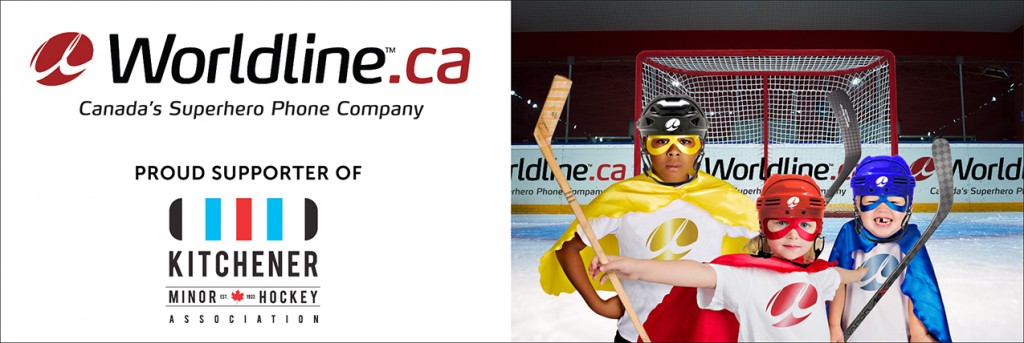
Press Release: Worldline partners with the Kitchener Minor Hockey Association

KMHA_WORLDLINE Worldline partners with the Kitchener Minor Hockey Association
Another Example of their Continuing Commitment to Canadian Youth

CAMBRIDGE, ONTARIO–(11/21/13)- Worldline, Kitchener’s Home Phone, Unlimited Internet and Long Distance company, is thrilled with their association with the Kitchener Minor Hockey Association for the 2013/14 season.  Going “Beyond Telecom” is what Worldline is all about, and Worldline’s 200+ employees, many of whom live in the region, look forward to supporting the these “Superhero Kids” as they learn the benefits of education, fitness, leadership, teamwork, community and responsibility through the KMHA.

Worldline is helping to offset expenses for kids in the community who, without assistance, would not be able to fully afford the opportunity to participate in organized hockey in the City of Kitchener.

Worldline Co-Founder and CMO John Stix said, “We are very proud of our association with the Kitchener Minor Hockey Association. Our Superhero Kids campaign is much more than a cute look. It reflects what we represent and believe in as an organization. We believe that every kid deserves the chance to be a Superhero on the ice, at home, in school and in the community and Worldline will continue to invest to help support our children’s dreams.”

KMHA is pleased to welcome Worldline to the KMHA family of Community sponsors. Their generous support and the community partnership that we have created will assist us in providing a beneficial service to the many participants at KMHA,” said KMHA General Manager Rolland Cyr.

“On behalf of the Board of Directors, our Midget AAA program, and the Hockey community at large, we say Welcome!”

KMHA if one of few minor hockey associations that cover the breadth of Hockey under one umbrella. They offer Girls and Boys all levels of competition, learn to play programs, spring non traditional programs as well as Special Hockey (for those with mental or social impairments that complicate participation in mainstream Hockey Programming).

About Worldline:
Celebrating its 10th anniversary in 2013, Worldline provides affordable home phone, unlimited high speed Internet and long distance services to hard working Canadians. One of the fastest growing telecommunications companies in Canada, Worldline is wholly owned and operated by Fibernetics Corp, a Competitive Local Exchange Carrier (CLEC) servicing over 300,000 Canadians coast-to-coast.
Website: worldline.ca Twitter: @worldlinecanada

About the Kitchener Minor Hockey Association:
Mission Statement: To provide a hockey program that promotes the importance and understanding of work ethic, good sportsmanship, discipline, team work and the fair treatment of others under all circumstances and all conditions. To teach respect for others, regardless of race, place of origin, family circumstance, gender or creed. To encourage players to uphold these principles and to become fine young adults, contributing to the community after their playing involvement is over.

###

Media Inquires:
John Stix – CMO
Worldline
519-489-6700
jstix@corp.fibernetics.ca

The Internet of Things: The Future is Going to be Very Different/Cool/Scary

How’s your heart today? How about your car’s fuel efficiency? Are the eggs you’re planning to have for breakfast on the verge of turning nasty?

Soon, very soon, all that information will be instantly available… for better or for worse.

Fibernetics is in the data delivery business. Through NEWT and Worldline, we’re providing Canadians across the country access to Internet with Unlimited high speed packages at sensible pricing.

That’s us today.

What we are also doing today is planning for the future. We have to be working on what will we be doing five, ten, twenty years from now.

And almost certainly what we will be doing is called the Internet of Things.

Coined in 2009, the Internet of Things (IoT) is a concept where essentially everything, your car, your toaster, you, me, your dog, are provided with unique identifiers and the ability to automatically transfer data over a network without requiring human-to-human or human-to-computer interaction.

thing, in IoT can be a person with a heart monitor implant, a farm animal with a biochip transponder, a car that has built-in sensors to alert the driver when tire pressure is low — or any other natural or man-made object that can be assigned an IP address and provided with the ability to transfer data over a network. So far, the IoT has been most closely associated with machine-to-machine (M2M) communication in manufacturing and power, oil and gas utilities. Products built with M2M communication capabilities are often referred to as being smart.

As time moves on, plenty more “things” are going to get a whole lot smarter and the implications of this kind of universal connectivity are both super cool – and also super scary.

First the Cool

Your smart phone will soon be a conduit of information about everything about you. From your own body, your kids and pets, to your car and your house, there will be practically nothing you can’t find out through a mobile app.

Just this week, GE announced their partnership with an IoT start-up who is beginning with monitoring, of all things, the eggs in your fridge. This device sits in your fridge and records the age and number of your eggs and sends a reminder when it’s time to shop.

Quirky, but extrapolate that onto everything you purchase, use or basically come into contact with.

Projections state IoT will involve approximately 212 billion things by the end of 2020, including intelligent systems designed to keep track of their own status and report it, as well as the continuing digitization of pretty much everything that is a thing.

Here’s the Scary Bit

As more and more personal and household devices are connecting to the internet, from your television to your car navigation systems to your light switches, more and more can possibly be accessed without your permission or your knowledge.

You thought the NSA scandal, where they tracked who you called on your cell phone, was intrusive? Imagine that kind of scrutiny multiplied to the nth degree with an IoT. Former CIA Director David Petraeus said the intelligence community cannot wait to spy on you through them.

Earlier this year Petraeus mused about it’s emergence  and he described it thusly:

“‘Transformational’ is an overused word, but I do believe it properly applies to these technologies, particularly to their effect on clandestine tradecraft.”

All those new online devices are a treasure trove of data if you’re a “person of interest” to the spy community. Once upon a time, spies had to place a bug in your chandelier to hear your conversation. With the rise of the “smart home,” you’d be sending tagged, geolocated data that a spy agency can intercept in real time when you use the lighting app on your phone to adjust your living room’s ambiance.

“Items of interest will be located, identified, monitored, and remotely controlled through technologies such as radio-frequency identification, sensor networks, tiny embedded servers, and energy harvesters — all connected to the next-generation internet using abundant, low-cost, and high-power computing,” Petraeus said, “the latter now going to cloud computing, in many areas greater and greater supercomputing, and, ultimately, heading to quantum computing.”

Petraeus allowed that these household spy devices “change our notions of secrecy” and prompt a rethink of “our notions of identity and secrecy.”

No kidding.

All of this will be sorted out over time. For us, being in the data business is a great thing because more and  more we are all going to become increasingly dependent on reliable, robust and secure data connections. It’s an obvious business strategy to continue to improve on our national infrastructure.

As for the rest, the future is going to be an interesting time, for better for sure when it comes to our personal health and convenience. Yet worse when it comes to… well, we’ll just have to see, won’t we?

Worldline programmer and official photographer, Peter Loeppky

A recent study of “Lake Fibernetics” by our in-house photographer, Peter Loeppky