Worldline Customer Care

Call Centre

No one wants to feel like they’re going into battle every time they have to call their internet service provider.

Being an internet provider goes above and beyond just offering internet service for our customers; we also have a responsibility to our customers and help them when needed with their internet service. We strive to provide Canadians with the best possible customer service, as well as the best Internet and Phone services at a fair price.

A recent article from CBC News looked into telecom call centre workers being reprimanded for reducing plans and offering credits to customers. It took a gruesome look into certain sales practices, as a handful of call centre employees for Rogers, Fido, and Bell spoke out. The CRTC is now preparing to hold a public hearing on the sales practices in the telecommunications industry, which is set to begin Oct. 22.

With more reports coming out about ‘aggressive’ telecom practices, we’re taking this opportunity to emphasize our commitment to customer satisfaction, and our agents who will always offer the best possible prices to consumers.

Beyond Telecom

Worldline has created a company culture centred around “delivering happiness and connections every day,” and we live by that promise when it comes to customer care.

“Our agents come in every day with the anticipation of providing exceptional customer service,” replied Peter Cross, the VP of the Fibernetics Call Centre. “There are no incentives and no penalties for discounting or cancelling customer plans. We encourage our agents to harness their empathy skills rather than coercion tactics, so we can keep all of our customers happy and satisfied.”

Worldline agents will never avoid having to reduce a customer’s plan but instead will embrace the needs of our customers and ensure that they are receiving reliable service. We value all of our Worldline customers and are dedicated to providing them with the best care and service in the industry.

Our Pledge to Canadians

We pledge to save our customers from being overcharged for their Home Phone, Long Distance and Internet services. Worldline is on the side of those who want great service at the best price.

We’ve always put the customer’s needs first, and that’s why we:

  • Don’t need to lock our customers into a contract; we earn their business every single day.
  • Offer unlimited Internet, with no extra charges or caps on bandwidth
  • Offer exceptional service at a low cost
  • Have a contact centre committed to helping our customers

We want to take this opportunity to thank our customers for helping us grow. Because we execute on our pledge, beliefs and values on a regular basis, word of mouth is our largest source for new customers.

To learn more about Worldline, please visit worldline.ca. We look forward to earning and keeping your business!


Young People & Mental Health in a Changing World

Every year on October 10th, The World Health Organization (WHO) joins in celebrating World Mental Health Day.

World Mental Health Day celebrates the initiative of the World Federation of Mental Health which helps raise awareness for mental health issues. The 2018 World Mental Health Day campaign focuses on Young People and Mental Health in a Changing World.

The expanding use of online technologies brings additional pressures to today’s youth and young adults, as connectivity to virtual networks is growing. As young people spend most of their day on the internet – experiencing cyber crimes, cyberbullying, and playing violent video games – suicide and substance abuse numbers are steadily rising. In addition to that, young adults are at the age when serious mental illnesses can occur. Unfortunately, youth and young adults are taught little to nothing about mental illness and wellbeing.

We want to bring attention to the issues our youth and young adults are facing in the world today and begin the conversation around what they need to grow up healthy, happy and resilient. Here are five online resources and apps to help youth and young adults navigate through their daily lives.

mindyourmind

mindyourmindmindyourmind exists in the space where mental health, wellness, engagement and technology meet. This online resource works with community partners and young people aged 14 to 29 to co-create interactive tools and innovative resources to build capacity and resilience.

Kids Help Phone

Kids Help LineKids Help Phone provides toll-free, 24/7, bilingual, anonymous, confidential phone and web counselling to those under 20 years old. The website has educational information on topics such as bullying, dating, emotional health, family, friendship, sexual orientation and more. There are separate sections for kids and teens.

TeenMentalHealth.Org

logo-for-webThis website has evidence-based resources (downloadable publications, videos, clinical tools, etc.) on a variety of mental health issues such as mental disorders, sleep, stigma, teen brain, etc. There are separate sections for teens and families, educators and health professionals and a searchable resource library. The website is sponsored by IWK Health Centre, Dalhousie University, Sun Life Financial and more.

Talkspace

TalkspaceTalkspace is an online and mobile therapy company that gives users access to licensed therapists through their website or mobile app on iOS and Android. Talkspace does not try to replace in-office treatment but helps users overcome their day-to-day challenges in a stigma-free environment. Therapy is offered through text messages, audio messages, as well as picture and video messages in a private, text-based chat room. Starting at $49 a week, Talkspace makes therapy available and affordable for all.

Calm

Calm AppCalm is the #1 app for meditation and sleep. Visitors can choose the length of meditation session they would like: Five options are ranging from 2 to 20 minutes. Guided and unguided sessions are available, and visitors can select a nature scene to view using arrows at the bottom right of the screen. The meditations are designed to help quiet the mind. Although the app is free, Calm costs $60 a year after a 7-day free trial.

Let’s all use this year to emphasize the needs of our young people and break the stigma surrounding mental health. 


The Future of Online Privacy

5 Ways to Protect Yourself Online

Over the last few months, there have been numerous data breaches and information-sharing scandals that have reinforced the scary fact that we are no longer in control of our personal online information.

Facebook

Last month, the Cambridge Analytica scandal – where the British consulting firm was revealed to have collected the data of up to 87 million Facebook users – sparked a movement with online behaviour.

Now, the latest scandal about Rogers email changes is causing concern among subscribers. According to comments submitted to MobileSyrup, Rogers email users are receiving notifications regarding new Oath terms of service intended to unify the privacy policies of both Yahoo and AOL users. Buried in a 27-page document is a special condition for Canadian users stating that all communications will be analyzed and used to deliver personalized advertising and services.

How much of our personal information is accessible and what can be done to protect it?

Changes to terms and policies have people more concerned about their private information. Regrettably, the only foolproof way to be private online is to delete all your accounts and never use the internet. Since avoiding the internet is next to impossible in today’s world, here are some ways you can take control of your online identity.

  1. Familiarize yourself with privacy settings

Computers, smartphone and internet services have made our lives easier, but did you know that there is a privacy dashboard under each of their settings? You can customize various options within the privacy settings and make sure that the apps you’re using only have access to necessary information.

  1. Find out what information is out there

It’s important to be aware of what information is being used and by whom. Most online companies will allow you to see the data they have. Here’s where to find your data on Google, Facebook and Twitter. You can also see the data that influences Facebook’s ads towards you here.

  1. Use strong passwords

We’re all guilty of using the same password for more than one account, after all, passwords are difficult to remember. Try using a different, and more secure password for all your online accounts. You can keep track of them with password managers, an excel spreadsheet or a piece of paper stored in a safe place.

  1. Delete unnecessary apps, extensions and services

Cambridge Analytica got its Facebook user data through a personality quiz app on the social network. Check out what apps you’ve given access to on Facebook and delete ones you don’t recognize or use anymore.

  1. Read the Terms of Service and Privacy Policy

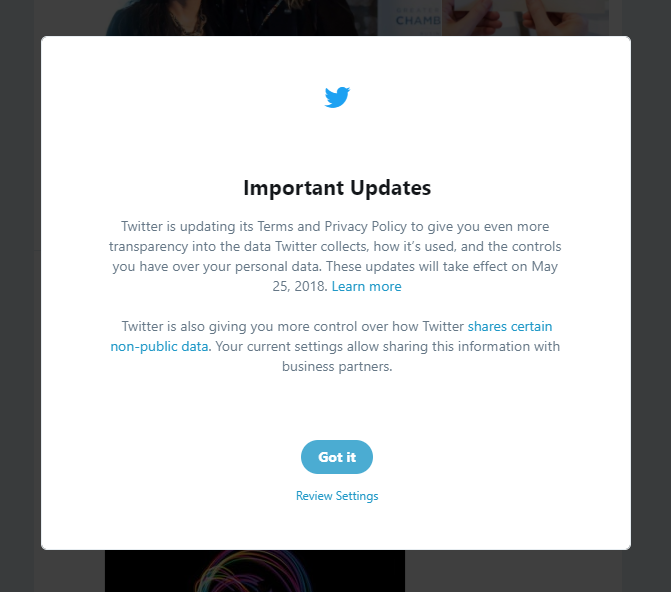
Twitter's Privacy Policy

Twitter and Instagram recently notified users of changes regarding Service and Privacy Policies. Along it may seem painstaking, read through the document and familiarize yourself with the new terms and policies, that way there are no surprises later.

More About Bandwidth: What Is Bandwidth, And How Does It Affect You?

moreaboutbandwidth

It’s safe to say that the traditional means of discovering information is changing immensely.

Dictionaries, novels, and entertainment have all been replaced with digital, more accessible versions via the World Wide Web that have Canadians connected to the Internet more than ever. With an average of seven active connected devices in homes across North America, according to a study conducted by Sandvine, people are constantly looking to their devices for both answers and entertainment. But relying on the Internet comes with a price, and we’re not talking about the cost of your communications bill. Surfing, streaming and gaming costs a little something called ‘bandwidth.’

Bandwidth describes the maximum data transfer rate of a network or Internet connection. It measures how much data can be sent over a specific connection in a given amount of time, according to TechTerms.com.

For the average person, the definition of bandwidth may be slightly confusing. Yes, it describes the maximum data transfer rate of a network or Internet connection – but what does that mean to you? In layman’s terms, have you ever look at your bill at the end of the month and realize you have been over charged? Your day-to-day may include hours of utilizing the web: searching new recipes, scrolling through social media platforms, online shopping, etc. Each of these online activities cost bandwidth – and if you don’t have an unlimited bandwidth package with your ISP provider, it’s not difficult to surpass your data cap that is determined when you sign up with an ISP.

But, who wants to have limits on Internet? With over 3 million Canadians connected to the Internet, technology has become an essential in our daily lives. It’s no longer reasonable to put limitations on Internet, especially when aspects of our lives may rely on being connected. As both a source of entertainment and a tool to enhance our lives overall, technology is becoming the answer to both our needs, and desires.

You may see reference to data caps, or broadband caps, while surfing around for a new ISP. Essentially, A broadband or data cap is the limitation in which an Internet Service Provider provides at your time of signing up, for an agreed-upon charge. If you exceed that limit at the end of the month – you’re greeted with a bill with overcharges. With a data cap, enjoying the web becomes a hassle, and since streaming is extremely popular nowadays, ISP’s are happily imposing bandwidth caps in order to achieve profit from your hours of watching cat videos.

So, you’re currently using a plan that has a data cap, what do you do? Determining how you utilize the Internet is the first step to knowing how much data you truly need. For example, browsing the Internet can use up less data than streaming videos. If you’re an avid ‘streamer,’ you may consider switching to an unlimited bandwidth package with an ISP. It’s also important to determine how much data you may use, as you utilize the Internet in your preferred way. Streaming YouTube can vary in data usage per hour, depending on the quality of videos you are streaming and gaming can actually use less data than streaming, based on several variables like the type of game, quality, etc. Downloading, uploading, sending e-mails and using social platforms all vary in usage. There are websites that automatically calculate an estimated data usage per month in your household, based on your implemented hours on these platforms, in order to have an idea of your total monthly usage. You can find an estimate for each of these mediums online, but it’s hard to pin-point exactly how much bandwidth they use.

Don’t want to deal with all this? We get it. If you’re a technology lover, and love to be connected to the web at all times, the last thing you want to worry about is bandwidth. Find yourself an ISP that offers unlimited bandwidth – so you can utilize the Internet the way you want to, without the hidden fees and the unexpected overcharges.

CRTC Ruling states Broadband Internet should no longer be limited to specific regions, and is now a basic service for everyone

internet

The Internet is a basic service in the lives of Canadians. With over 3 billion people worldwide utilizing the web, Canadian’s should no longer be deprived of broadband Internet services. The CRTC is making a change that will benefit the lives of those Canadian’s that live in rural areas, making broadband Internet services available to all.

This new ruling has ISP’s striving to meet the goal of providing rural customers at least 50 megabits per second download speed, and upload speeds of at least 10 megabits per second, and options for unlimited data. According to the CRTC, “two million Canadian households, or roughly 18 per cent, don’t have access to those speeds or data.” Broadband is now deemed as a basic service, regardless of where a person lives. The CRTC expects fixed broadband Internet of at least 50/10Mbps to be available in 90% of Canadian households by the end of 2021, and in the remaining 10% within 10 to 15 years.

The CRTC states that fast Internet speeds and the ability to download content quickly is no longer a superfluity, as people rely heavily on the Internet to do essential, daily actions such as online banking, distance education, government services, telehealth, and much more. Having the option for fast speeds and unlimited data is a must.

Worldline is dedicated to applying these changes to better serve our customers that reside in rural areas. Although specific implementation details from the ruling have yet to be determined, Worldline is better preparing their services for the upcoming changes. Aside from the minimum 50 megabits per second download and 10 megabits per second upload speeds, the CRTC has issued changes that must be implemented within the next six months such as contracts and services must be explained in clear language to ensure customers are completely aware of what’s included and offered. 

Overall, this ruling is paving the way for Canadian’s to make more informed decisions about their telecommunications services, and to offer more to those in rural areas – because everyone deserves fast, reliable broadband Internet

Looking to switch to Worldline telecom services? See what they have to offer in your area today.